Understanding the Science Behind UV-C Disinfection
What is UV-C Disinfection?
If you’ve ever wondered what UV-C disinfection is, here’s the simple version. UV‑C is a short‑wavelength band of ultraviolet light that doesn’t reach us naturally because the ozone layer absorbs it. In a controlled device, we recreate that light and aim it at objects or air to stop microbes from multiplying. No sprays, no residues, just light doing highly targeted work.
That’s why UV‑C fits so neatly alongside everyday cleaning. Wipes lift dirt, UV‑C finishes the job by dealing with what you can’t see. For busy teams handling shared tech, VR headsets, tablets, and handheld scanners, that extra assurance matters. New to the topic? Start with our overview of the technology and safety principles.
The Science Behind UV-C Light
Think of the spectrum of light as a ruler. Visible colours sit in the middle. Slide left into shorter wavelengths and you enter ultraviolet. The electromagnetic spectrum UV-C lives between 200–280 nm, with a strong germicidal peak close to 254 nm. Those UV‑C wavelength nanometers carry enough energy to damage the genetic material of microbes.
Here’s the important bit for decision‑makers: genetic material, DNA in bacteria and many viruses, RNA in others, soaks up this light. The energy causes bonding errors (for example, thymine or cytosine dimers), which breaks the organism’s ability to copy itself. No replication, no colony. This is the core science behind UV‑C light.
Dose matters. Peer‑reviewed studies show that relatively modest doses (often in the low tens of mJ/cm²) can inactivate many viruses and bacteria, provided the light reaches them directly. Equally, two environmental factors change performance: distance (intensity drops with the square of the distance) and shadowing (objects block light). Good design tackles both with reflective interiors, consistent lamp output, and validated cycle times.
If you’d like the long‑form evidence base, an independent review in the Journal of Hospital Infection walks through wavelength, dose, and limitations in clinical spaces. We recommend it as a balanced technical read (see the open‑access summary on the National Library of Medicine).
How Does UV‑C Disinfection Work in Practice?
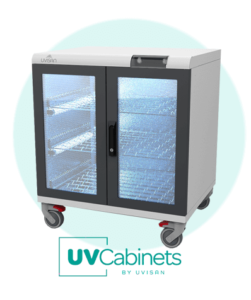
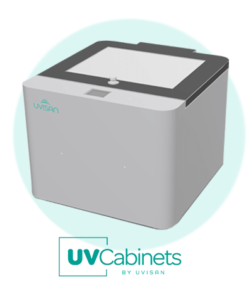
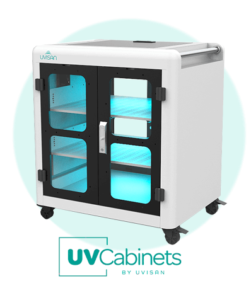
Load the items, close the door, run the cycle. Inside a Uvisan cabinet, calibrated lamps flood the chamber with a controlled dose. That dose is measured in millijoules per square centimetre and is delivered over a short period, typically around two minutes in our cabinets. The result is fast, reproducible microbial reduction without liquids, heat, or abrasion. This is the proven mechanism of UV‑C disinfection.
Because the process is line‑of‑sight, physical cleaning still matters. Dust, fingerprints, or layers of grime can shield microorganisms. The best routine is simple: wipe to remove visible soil, then run UV‑C to finish the job. It’s the same principle hospitals use to combine manual cleaning with automated systems. See how this plays out day to day in our piece on infection control in healthcare settings.
UV-C light vs Traditional Disinfection Methods
This isn’t a turf war, UV‑C light vs traditional disinfection makes the most sense as a layered approach:
Sprays and wipes remove soil and are familiar to staff, but can miss crevices and hinges, and are user‑dependent.
Fogging can reach wide areas, but it’s slow to deploy and requires ventilation/downtime.
Cabinet‑based UV‑C disinfection technology adds speed and consistency for small, shared items, especially electronics, without moisture or chemical residues.
In real deployments (including NHS trusts and simulation centres), adding UV‑C has been linked with measurable reductions in surface contamination on shared devices. For operators, the benefit is simple: a predictable, short cycle you can fit between handovers. Want a plain‑English walkthrough of the benefits? Read our blog, the power of UV‑C.
Applications of UV-C Disinfection Technology
UV‑C has a range. Here are typical use cases we support across sectors:
VR/AR/XR & tech rental: Turn headsets and controllers around quickly between sessions. Our racks and cable management keep charging tidy while cycles run.
Education: Disinfect class sets of tablets, laptops, and headsets between lessons without chemical smells in the room.
Healthcare & simulation: Treat high‑touch kit like blood‑pressure cuffs, stethoscopes, probes (where clinically appropriate), and shared tablets with repeatable, logged cycles.
Corporate & enterprise: Keep hot‑desk peripherals, meeting‑room accessories, and loaner devices ready without adding wipes to the consumables budget.
Creative/media production: Protect sensitive cameras, mics, and comms equipment from moisture and solvent exposure while maintaining hygiene on set.
Public & government venues: Museums and libraries process handheld tour devices in batches. Transport hubs can turn around handheld scanners and radios between shifts.
Clinical, laboratory, pharmaceutical, cleanroom: Support SOPs with timed, documented cycles and a dry, residue‑free process compatible with electronics.
So, is UV‑C light effective against bacteria? The short answer is yes, provided dose and exposure are correct. Viruses and yeasts respond at different dose levels, but the principle is the same: block replication, reduce risk.
The Future of UV-C Disinfection
Two developments are worth watching:
Deep‑UV LEDs. They’re getting more efficient each year and removing mercury from the equation. LEDs also offer precise wavelength control and instant on/off, which helps with energy use and system life.
Far UV‑C (around 222 nm). Early research suggests it may be safer for use in occupied spaces due to shallow penetration into the skin and eyes. It’s promising, but standards and long‑term data are still maturing. Until then, we design for enclosed, user‑safe systems in line with current evidence on UV‑C radiation for sterilisation.
Engineering also matters: dose monitoring, lamp ageing compensation, and reflective geometry all contribute to consistent outcomes, cycle after cycle.
Why UV-C Disinfection Matters
For teams that share devices, the appeal is practical:
Speed. Typical cabinet cycles complete in a couple of minutes.
Consistency. A set, validated dose each time.
Compatibility. No liquids or heat around electronics.
Sustainability. No wipes to landfill, no chemical residues.
Used with routine cleaning, UV‑C delivers the reliability modern environments expect. If you’re building a hygiene standard for classrooms, clinics, studios, or enterprise fleets, this is a proven way to raise the bar, quietly.
Explore the underlying science on our technology page. If you need help scoping capacity (how many headsets per cycle, how many cycles per day), we’re happy to advise.